Mortuary Temple of Queen Hatshepsut Catacomb of Priscilla Good Shepherd Ap Art History

THE CHRISTIAN CATACOMBS
Origin of the catacombs
Characteristics of the catacombs
Catacombs in Italian republic and around the world
The art of the catacombs
The catacombs and the Female parent of God
The Good Shepherd in the catacombs
The martyrs of the catacombs
The catacombs and the Fathers of the Church
The Pontiffs restore the catacombs

Rome, Catacombs of Priscilla – Gallery of sandstone
Origins of the catacombs. The catacombs originated in Rome between the end of the 2d and the get-go of the third centuries A.D., under the papacy of Pope Zephyrin (199-217), who entrusted to the deacon Callixtus, who would afterward become pope (217-222), the chore of supervising the cemetery of the Appian Way, where the most important pontiffs of the third century would be buried. The custom of burying the dead in cloak-and-dagger areas was already known to the Etruscans, the Jews and the Romans, but with Christianity much more complex and larger burial hypogea originated in order to welcome the whole community in only 1 necropolis. The ancient term to designate these monuments is coemeterium, which derives from the Greek and means "dormitory", thereby stressing the fact that for Christians, burial is merely a temporary moment while they wait for the final resurrection. In antiquity, the term catacomb, extended to all the Christian cemeteries, but defined the complex of St. Sebastian on the Appian Way.
Return to Index

Rome, Catacombs of Priscilla – Gallery with closed loculi
Characteristics of the catacombs. The catacombs are, for the most role, excavated in tuff or in other easily removable but solid soils so equally to create a negative architecture. For this reason, the catacombs are institute peculiarly where there are tufacious types of soil: that is, in central, southern and insular Italy. The catacombs entail the presence of ladders that lead to ambulatories which are called galleries, as in mines. In the walls of the galleries the "loculi" are arranged: that is, the burial places of ordinary Christians that are made lengthwise. These tombs are airtight with marble slabs or bricks. The loculi represent the humblest and most egalitarian burial system in order to respect the community sense that animated the early on Christians. In any consequence, in the catacombs more complex tombs are as well constitute, such equally the arcosolia, which entail the earthworks of an arch on the tuff casket, and the cubicula, which are real and proper burial chambers.
Return to Alphabetize
Catacombs in Italy and effectually the world. Most of the catacombs are found in Rome where they number nearly sixty, while the same number can be counted in Latium. In Italy, the catacombs developed especially in the South where the soil consistency is harder but at the same fourth dimension more ductile for digging. The northernmost catacomb is the one that developed on the Island of Pianosa, while the southernmost cemetery hypogea are the ones in northern Africa and especially at Hadrumentum in Tunisia. Other catacombs are found in Tuscany (Chiusi), Umbria (almost Todi), Abruzzi (Amiterno, Aquila), Campania (Naples), Apulia (Canosa), Basilicata (Venosa), Sicily (Palermo, Siracusa, Marsala and Agrigento), and Sardinia (Cagliari, Southward. Antioco).
Render to Alphabetize

Rome, Catacombs of Priscilla – three children in the furnace
| The art of the catacombs. From the finish of the second century, an extremely simple art adult in the catacombs which is in part narrative and in part symbolic. The paintings, mosaics, reliefs on the sarcophaguses and small arts recall stories from the Onetime and New Testaments, as if to present the examples of salvation from the past to the new converts. This is why Jonah is often depicted who was saved from the abdomen of the whale where he remained for three days, which re-evokes Christ'southward Resurrection. |  Rome. Catacombs of Sts. Marcellinus and Peter – Jonah is vomited out Rome. Catacombs of Sts. Marcellinus and Peter – Jonah is vomited out |
| From the New Testament, the miracles are chosen of healing (the blind human being, the paralytic, the hemorrhaging woman) and resurrection (Lazarus, the widow of Naim's son, Jairus' girl), but also other episodes, such as the conversation with the Samaritan adult female at the well and the multiplication of the loaves. |
 Rome, Catacombs of St. Sebastian – Funeral inscription with symbols Rome, Catacombs of St. Sebastian – Funeral inscription with symbols | The art of the catacombs is also a symbolic fine art in the sense that some concepts which are difficult to express are represented in a simple style. To signal Christ a fish is depicted; to signify the peace of heaven a dove is represented; to express firmness of faith an anchor is drawn. On the closing slabs of the loculi, symbols with dissimilar meanings are oft engraved. In some cases, a tool is depicted which indicates the expressionless person's trade in life. Some symbols, such as spectacles, loaves of bread and amphorae, allude to the funeral meals consumed in honor of the deceased, the so-called refrigeria. Most of the symbols refer to eternal salvation, such as the dove, the palm, the peacock, the phoenix and the lamb. |
Return to Alphabetize

Rome, Catacombs of Priscilla – Our Lady with the Prophet
The catacombs and the Female parent of God. In the Roman catacombs the nearly ancient epitome is preserved of Our Lady who is depicted in a painting in the cemetery of Priscilla on the Via Salaria. The fresco, which can exist dated back to the first half of the tertiary century, depicts the Virgin with the Child on her knees in front end of a prophet (perhaps Balaam or Isaiah) who is pointing to a star to refer to the messianic prediction. In the catacombs other episodes with Our Lady are also represented such as the Adoration of the Magi and scenes from the Christmas crib, simply information technology is thought that prior to the Council of Ephesus, all these representations had a Christological and not a Mariological significance.
Return to Alphabetize
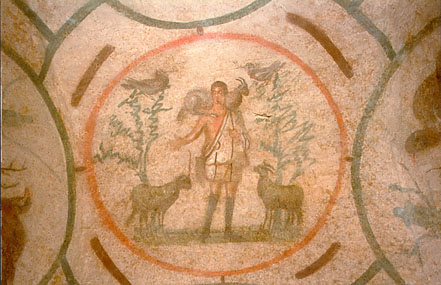
Rome, Catacombs of Priscilla – The Practiced Shepherd
The Good Shepherd in the catacombs. 1 of the images represented the most in the art of the catacombs is the Skilful Shepherd. While the model is taken from infidel civilization, information technology immediately takes on a Christological significance inspired by the parable of the lost sheep. Christ is thus represented as a apprehensive shepherd with a lamb on his shoulders equally he watches over his niggling flock that is sometimes made up of just ii sheep placed at his sides.
Return to Index

Rome, Catacombs of St. Sebastian – devotional graffiti
The martyrs of the catacombs. In the catacombs, the martyrs are buried who were killed during the roughshod persecutions willed past Emperors Decius, Valerianus and Diocletian. Effectually the tombs of the martyrs, a form of devotion developed rapidly amidst the pilgrims who left their graffiti and prayers at these exceptional burial places. The Christians tried to arrange the burying places of their deceased as close as possible to the martyrs' tombs because it was thought this would also found a mystical nearness in heaven.
Render to Alphabetize
The catacombs and the Fathers of the Church. Between the end of the fourth and the beginning of the 5th centuries, the Fathers of the Church described the catacombs. St. Jerome was the first to recount how as a student he would proceed Sundays to visit the tombs of the apostles and the martyrs together with his study companions: "We would enter the galleries dug into the bowels of the earth…Rare lights coming from above country attenuated the darkness a footling…We would keep slowly, one step at a time, completely enveloped in darkness". The Iberian poet, Prudentius, also recalls that in the early years of the fifth century, many pilgrims would come from around Rome and fifty-fifty from the surrounding regions to venerate the tomb of the martyr Hippolitus who was buried in the catacombs on the Via Tiburtina.
Return to Index
The Pontiffs restore the catacombs. In the 2d half of the quaternary century, Pope Damasus began the search for the tombs of the martyrs located in the different catacombs of Rome. After the tombs were found, he had them restored and had first-class praises engraved in laurels of these starting time champions of the faith. In the sixth century, Popes Vigilus and John III likewise restored the catacombs later the incursions due to the Greek-Gothic war. Subsequently, between the eighth and ninth centuries, Popes Hadrian I and Leo Ii also restored the martyrs' shrines in the Roman catacombs. After a long catamenia of oblivion, the rediscovery of these hypogea in the sixteenth century offered valuable testimonies of the outset Christians' genuine faith that were used by the Counterreformation movement. Finally, in the nineteenth century, Pope Pius Ix created the Commission for Sacred Archaeology in order to preserve and study in a fitting way the places of early Christianity.
Return to Alphabetize
Source: https://www.vatican.va/roman_curia/pontifical_commissions/archeo/inglese/documents/rc_com_archeo_doc_20011010_cataccrist_en.html

Post a Comment for "Mortuary Temple of Queen Hatshepsut Catacomb of Priscilla Good Shepherd Ap Art History"