Walter Benjamin Illuminations the Work of Art in the Age of Mechanical Reproduction
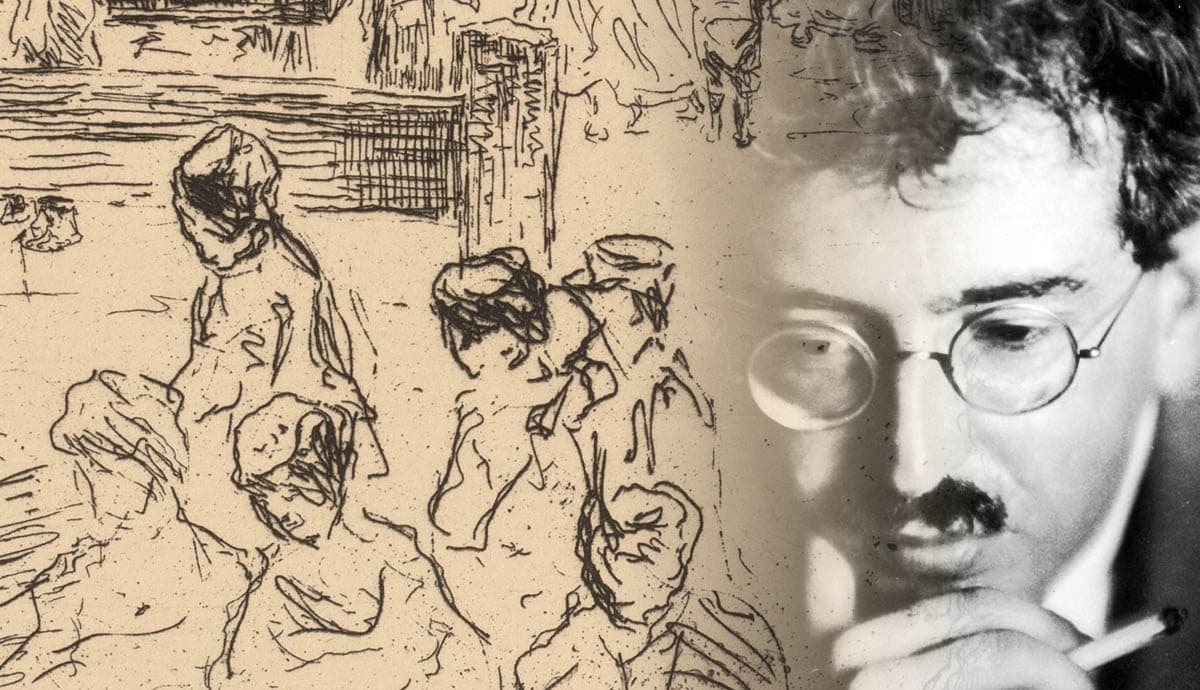
Walter Benjamin was one of the most influential contributors to Critical Theory. His ideas and ideology deep-dived into truths about gild, interconnecting different facets of human endeavor, from politics to art. Walter Benjamin is a philosopher who got to live through boggling times: born at the end of the 19th century, he saw the mass growth and expansion of several key industries – from car manufacturing to the appearance of movie.
Walter Benjamin: An Elusive Thinker

Walter Benjamin'south works range from topics like Phantasmagoria, a concept that was much more common in his time than it is today, to art criticism, all the way to discussions of translation theory. Oftentimes Benjamin would bounciness dorsum and forth using examples from all sorts of categories to build a broader pic for the reader, creating a fun and unique feel for studying philosophy. Many more well-known philosophers, such as Habermas and Derrida, would reference Benjamin's work and his influence on Critical Theory. During the Interwar Period in Federal republic of germany he was able to find a group of like-minded individuals at The Plant for Social Research. This grouping of boggling thinkers would become on to exist called The Frankfurt School.
The Frankfurt School: Finding Inspiration

The Frankfurt Schoolhouse was a large conglomeration of like-minded individuals who attempted to build a wider understanding of the social construction and development that was happening all around them. Walter Benjamin's close relationship with Theodor Adorno, also a member of The Frankfurt Schoolhouse, is what originally drew him into the school. The report and ideas coming out of the school often directly concerned the rise fascist movement that was forming in Germany at the time.
The changing times and the introduction of new technological marvels seemed to be a constant during Walter Benjamin's early 20s and well into his 30s. These advances were a source of inspiration for his philosophy. The introduction of moving pictures and film was particularly fascinating to Benjamin. While this fantastical growth in engineering science was occurring, a dark side of politics and society was ascent, too. Like many other scholars of the Frankfurt School, Walter Benjamin was a Jewish High german citizen, and ane that would be labeled a political dissident in the tardily 1930s. Due to his influential work in art theory, Benjamin became an enemy of item annotation to Hitler and his Nazi Political party.
Are yous enjoying this article?
Sign up to our Complimentary Weekly Newsletter
Please check your inbox to activate your subscription
Give thanks you!
Revolutionary Times: Benjamin's Tragic End

In 1932 the revolution in Germany that led to the ascension of Hitler to ability was unfolding. Fearful for his future, Walter Benjamin fled Federal republic of germany and settled in France. He would go on to live in and around Paris for the adjacent 5 years. Benjamin ran out of coin during this time merely was funded by Max Horkheimer, another member of the Frankfurt School. During this time he met and befriended other influential scholars such every bit Hannah Arendt, who had as well fled Nazi Frg. While in exile, he published his most famous work: Art in the Age of Mechanical Reproduction. He also entrusted his piece of work The Arcades Project to other philosophers from the Frankfurt Schoolhouse, a work that labeled 20th century Paris as the heart of the emerging new world and an influence upon nearly all facets of society.
In 1940 Benjamin and his family unit had to flee from Paris as the High german Army cruel upon France. The German Army had a specific warrant for the arrest of Walter Benjamin in his flat, upon entering Paris. Benjamin's plan was to travel to the U.s.a. via the and so neutral Portugal, but unfortunately never managed to make it there. Walter Benjamin fabricated information technology as far as Catalonia in Espana, just outside of French republic. Shortly later on crossing the border, the French police – at present nether High german control – canceled all travel visas and demanded the firsthand return of all immigrants from Spain, peculiarly the Jewish refugee group Benjamin was a role of.
On September 26th, 1940 Walter Benjamin committed suicide in a hotel room. Another member of the Frankfurt School, Arthur Koestler, also attempted suicide there notwithstanding was unsuccessful. The remainder of the group were allowed to go on out of Spain to Portugal. Unfortunately, Benjamin's blood brother George died at the Mauthausen-Gusen concentration camp in 1942. Thankfully, Benjamin's work The Arcades Project saw the lite of day after his re-create was given to The Frankfurt School. It is speculated that he had completed another work that went missing in the turmoil of his decease, though information technology is speculated that it could have just been a finalized version of The Arcades Project.
Art and the Age of Mechanical Reproduction

Diving deeper into Art in the Historic period of Mechanical Reproduction, Walter Benjamin discusses how the reproduction of art has demystified the purpose of the fine art. Benjamin theorizes that the purpose and goal of fine art is that of presence, the shared moment between the observer and the piece of art. He describes a very specific aura that is achieved at that moment.
This critique of artwork that Walter Benjamin offered in his work presented a novel perspective. While guild had had access to print and books for a long time by the 20th century, access to widespread photography via newspapers and journals created an unprecedented admission to fine art. This admission took abroad the majesty and presence that Benjamin institute so endearing within an artwork. Justifying art and recognizing its purpose became more difficult as technology brought u.s. closer together still farther from the specific aura of art.
20th Century: Movements Toward Mass distribution
Walter Benjamin witnessed the wide-calibration implementation of mass production and distribution in all aspects of society. He saw the ascent of ads and film and newspapers, as well as the rise of mechanical industries flourishing in factories. This mass distribution of goods and commodities to more people than ever was revolutionary and beneficial in the eyes of Walter Benjamin. Many of his colleagues at the Frankfurt School who happened to exist socialists or Marxists also saw the benefits to this new distribution, every bit it provided wider access to items that used to be reserved for the upper classes.
This distribution of appurtenances too led to a distribution of fine art and knowledge, both of which Benjamin took to critiquing. One of Walter Benjamin's works specifically talked about this commodification of knowledge, The Task of the Translator. He discussed the role and responsibleness of translating a work. While it might seem obvious to some that only substituting German words for French ones would exist the office of the translator, Benjamin points out that allegories, comparisons or examples in more complex works actually require an investigation into their deeper entrenched meaning.
Walter Benjamin had several of his own works translated from their original German to French, every bit he was residing in France near the cease of his life. His works were later on translated further into English. It is interesting that these manifold translations accept since resulted in slightly different titles for his piece of work Art in the Age of Mechanical Reproduction, providing an instance for his work The Job of the Translator.
Technology and Looking Backwards: The Printing Press
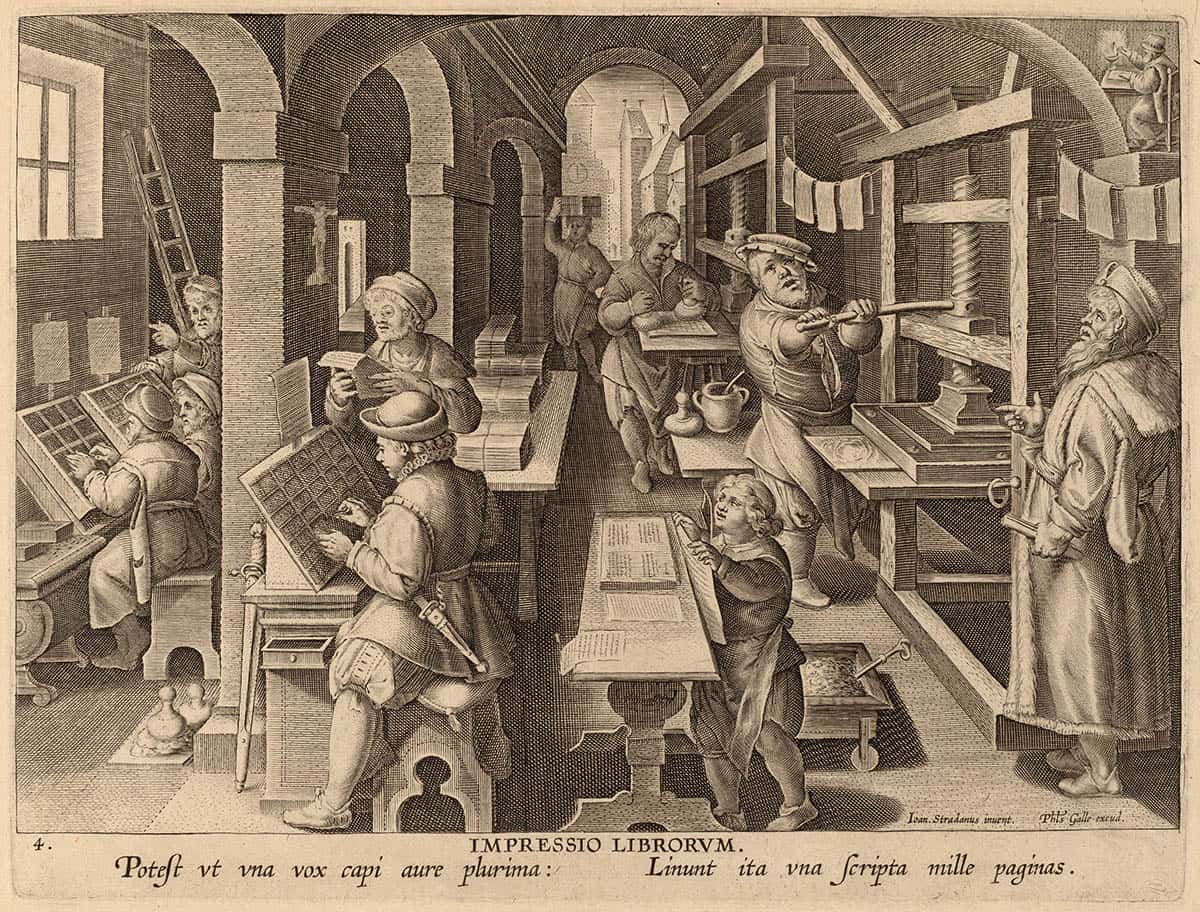
Walter Benjamin regularly used examples from the past within his works. He was interested in how product has changed in the past. For example, the Gutenberg Press inverse storytelling for all of society, and exemplifies one of the first massive changes in how information and art were distributed to everyone.
For much of history, storytelling was a grouping thing. People would assemble around a storyteller or orator who would give out information, frequently well-nigh society or myths that people already knew. Yet these stories were different every time they were told and they often pandered directly to the people they were being told to. Information technology could be unwise to tell a joyous story describing the feasts and privileges of a monarch to a group of oppressed and starving people: their anger could end up affecting the storyteller or orator. Walter Benjamin noticed that after the Gutenberg Printing revolutionized storytelling, forcing it into the format of the novel, the experience of storytelling became incredibly individualized and personal. Stories are now enjoyed in a placidity, private space instead of in a public one. This is an example of how technology tin can directly affect people's human relationship to art and noesis, and an omen of how engineering would inevitably alter information technology again in the future.
Technology and Looking Forward: The Advent of Film
Looking into the hereafter, Walter Benjamin referenced the mass changes he saw during his life. Specifically, the film industry was occupying the space of stories and storytelling and bringing it back to the masses. For the kickoff time in several centuries, storytelling went from being an private feel to becoming a group matter: showing up to the theater and enjoying a motion picture together. Equally a group, you would participate in the simultaneous and collective enjoyment or horror of the story. Then these groups would be able to discuss the story together afterward, freshly afflicted by information technology, a very different process from the private enjoyment of reading.
Walter Benjamin believed that this process would inevitably lead us back to individualization. Though he could not imagine how applied science would change he believed that picture show would eventually become something that was done in seclusion, in the privacy of one'southward own domicile. Similarly to what happened to stories after the invention of the printing press, nosotros now know that this process did occur. I doubt Benjamin, or anyone else for that matter, could accept imagined the effects of something as vastly influential every bit the net and online forums for discussions of things like Netflix, but it is still important to reflect on the influence of technology on our practices. Nosotros should take Benjamin's work and credo to effort to interpret the world around us, and possibly fifty-fifty predict what could happen through this constant ebb and catamenia that moves our practices from the private, to the collective, to the individual once again.
Lark equally a Reaction to the Modern Globe
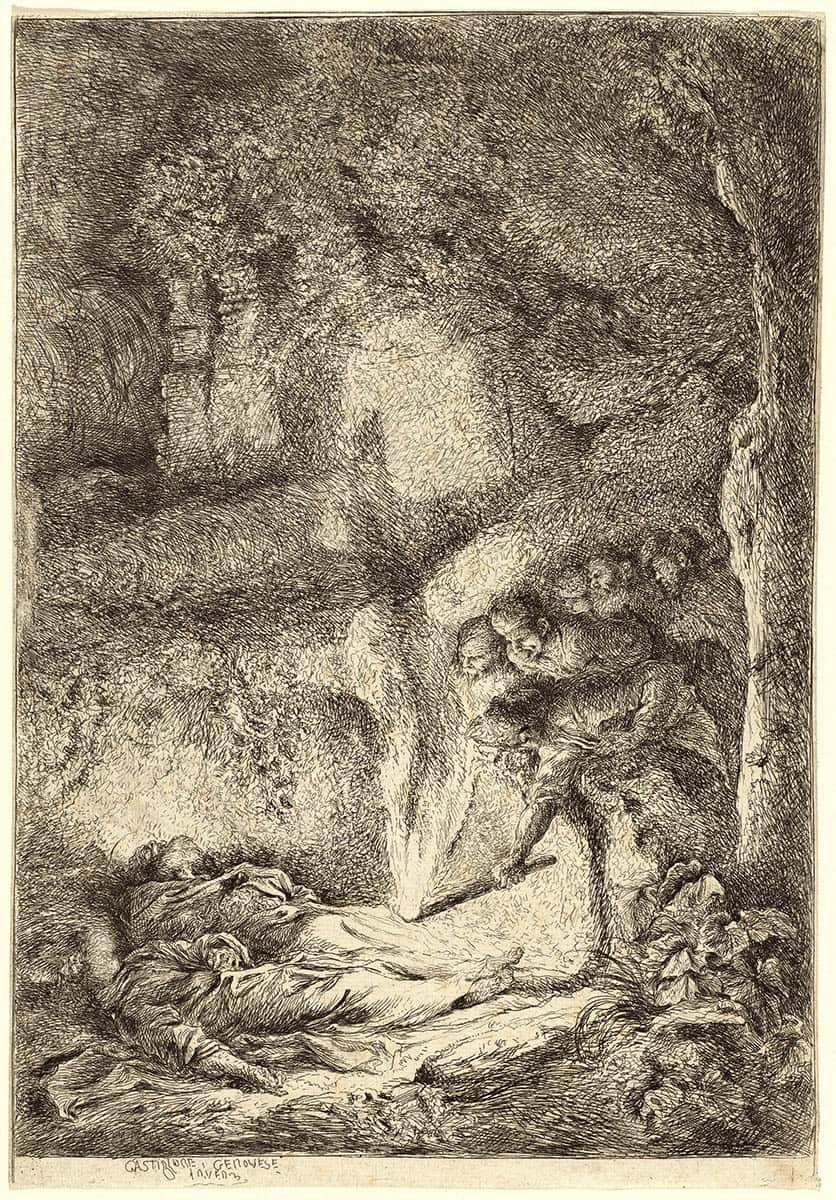
Walter Benjamin'south terminal work The Arcades Project , which was saved by members of the FrankfutSchool, was specifically about the civilization and impact of Parisian life on 20th century society. Equally we have mentioned in passing, Benjamin'south obsession with motion-picture show actually stemmed from something that people of the early 1900s would be very familiar with: Phantasmagoria Theater. Phantasmagoria was an invention that projected images onto a wall with the assistance of lanterns, transparent materials and smoke. Some projections could even involve several images, giving the appearance of a moving image. Phantasmagoria Theater oft took place in catacombs or other small confined and scary places effectually Paris where these groups would be told a story and and so shown these scary images which seemed to appear from nowhere.
This precursor to what we know as the projector and film was a mind-bending experience for people in the 19th century, as they had never seen anything like it before. The impact was a change in society's perception. Yet it came at a cost: this new and more than in-depth sensory feel was an overstimulating bombardment of experience for the everyday person at the time, and it led to a sort of lark. This distraction was a keyword in Benjamin's work, who used information technology to present a critique of guild and culture. While technological changes made many things more accessible, no one was discussing how to deal with such changes on a social level. This result is presenting itself in an even more marked fashion today.
Walter Benjamin: Phantasmagoria of Philosophy

Who knows if, given the fourth dimension, we would have seen an expansion of Walter Benjamin's philosophy to the problems of lark within gimmicky order? Unfortunately, due to the rise and threat of nationalism in Germany and the hatred that cut Walter Benjamin'south life short, we will never know. We tin can, however, look thoroughly at his work and use it to better understand how society affects art, knowledge, and our agreement of society. Nosotros can try to individuate our times' Phantasmagoria and build a philosophy around it, working to deal with the bug nosotros face up and planning for what volition come in the future. Walter Benjamin and The Frankfurt School sacrificed so much to give united states a framework of understanding; where we take it from hither is up to us.
Source: https://www.thecollector.com/walter-benjamin-art-technology-distraction/

Post a Comment for "Walter Benjamin Illuminations the Work of Art in the Age of Mechanical Reproduction"